Showing posts with label research. Show all posts

Tuesday, September 27, 2016

I Presented A Poster On SMARTA And Ruffed Lemur Color Vision At #DLC50

When you show up and your outfit and hair matches your poster and table. #OnFleek
My poster for Duke Lemur Center 50th Anniversary Scientific Symposium is now available online. Please click here. Thank you Duke Lemur Center for inviting me to present my research, especially Dr. Erin Ehmke.

My credentials ;)
SMARTA: Subject-Mediated Automatic Remote Testing Apparatus for Color Vision Discrimination Tasks in Ruffed Lemurs (Varecia spp.) 

ABSTRACT:

Polymorphic color vision in ruffed lemurs (Varecia spp.) occurs due to an allelic variation of a single x-linked opsin gene that results in individuals being either dichromatic (red-green colorblind) or trichromatic depending on their opsin genotypes. The link between genotype and phenotype is well-established in haplorhines but not well-studied in lemurs. To investigate the color vision genotype-phenotype link in Varecia spp., the subject-mediated automatic remote testing apparatus (SMARTA) was developed. It aims to reduce biases and to accurately test the color discrimination abilities of inferred dichromatic and trichromatic individuals. SMARTA is an innovative novel apparatus for behavioral touchscreen discrimination tasks. It is controlled remotely via a smartphone app, has a motorized conveyer that automatically dispenses food rewards, automatically logs data online, and is relatively inexpensive to build.


Saturday, April 9, 2016

I Talked About SMARTA and Ruffed Lemur Color Vision A Lot This Week

Duke Lemur Center presentation cover page

I gave a 30 minute presentation on Tuesday at Duke Lemur Center this week for their "Lemurs, Science, and Beer" seminar. The title of the talk is "Do You See What I See? Studying Ruffed Lemur (Varecia spp.) Color Vision using SMARTA".  In this presentation, I did a brief talk about how color vision came to be and what the world might look like for ruffed lemurs if they cannot see red or if they can see red. Then, I talked about my research questions and how I try to answer them by using SMARTA.

Hey, I know this Raymond Vagell guy! 

The event had a great turn out. It even attracted a few public attendees as I had advertised the talk on Facebook and Twitter. I'm glad that I was able to talk about what SMARTA is and how it is used to study ruffed lemur color vision to the DLC staff because they've seen me conducting my research but probably doesn't really know what I'm doing. Thanks to all my friends who came to support me. 

That's Carme using SMARTA

On Wednesday, I had the opportunity to talk about SMARTA and ruffed lemur color vision to Scaling Stem participants who came to visit DLC. I talked about how SMARTA came to be and how it was built. Then, I showed the participants how SMARTA works. Because this is a women in STEM group, it was apropos to have Halley demonstrate how SMARTA works. Without skipping a beat, Halley did her color vision trials perfectly and her enthusiasm wow-ed the crowd.

Giving a talk to Scaling Stem participants. Helping me demonstrate SMARTA is my lemur assistant, Halley

On Thursday, I gave a brief talk to a group of college freshmen that are interested in animal cognition studies. Though the talk was brief, I was able to share some tips on designing animal studies and things to expect when working with animals. This time, Carme helped demonstrate SMARTA. She also wow-ed the crowd with her cognitive skills in discrimination tasks.

Giving a brief talk about my color vision project 

This has been a long week! But, I am glad that I was given the opportunity to talk about my research and sharing my stories not only to the DLC staff, but also to educators and students. This week is also my last week at DLC for awhile. I am flying back to NYC and will be back to DLC periodically until the study is done around August. My assistant will be continuing this study while I am away. Thanks to Dr. Erin Ehmke for giving me the opportunities to share my work with the DLC family, educators and students.


Saturday, April 2, 2016

Lemur, Science, and Beer Talk: April 5th, 4PM at Duke Lemur Center

Come join me on Tuesday, April 5th at 4PM where I will be presenting a talk on my ruffed lemur color vision study titled "Do You See What I See? Studying Ruffed Lemur Color Vision using SMARTA. I will talk about the ruffed lemurs and their color vision, what SMARTA is, as well as how this study is conducted.


This event is open to the public and will be held at Duke Lemur Center in Lemur Landing (where the gift store is). I've started a Facebook event for this talk. Hope to see you all there!


Duke Lemur Center 
3705 Erwin Rd, Durham, NC 27705
Phone: (919) 489-3364
Lemur Landing is directly right in front of the parking lot.

Friday, April 1, 2016

Slow and Steady, Get Me Ready


It's been a few weeks since my previous post. We are still working with Carme, Pyxis, Celeste, and Pandora. Next week, we will be working with a new female. Great progress with Carme. Pyxis ... not so much. Celeste and Pandora are both starting to touch the screen so it's heading to the right direction.

Carme had improved tremendously since my last post. We have been training her daily to reinforce her to correctly station in front of SMARTA and to touch the squares deliberately instead of nonchalantly putting her hands between the squares or just touching the sides of the square. We also turn off the screen for a few seconds when she touches the incorrect stimuli or when we want to extinguish a certain behavior. It seem to have helped and by early this week, Carme is less frantic when using SMARTA and very rarely is swiping her hands all around the screen. When she make an incorrect choice, sometimes she gets a bit frantic but generally a major improvement than what she used to be a few weeks back. We thought that turning the screen off and turning it back on when she's paying attention to the screen helps to teach her that when she makes a mistake, it will take a few seconds before she can try to get a craisin. Of course, you don't want to turn off the screen for too long or it would stress the animal out. We generally turn it off for less than 5 seconds unless the animal is not paying attention to the screen (eg. looking at another animal, listening to alarm calls, etc).

By the end of next week, Carme will be done with the study as she would have done enough sessions for my data collection. I have enjoyed working with her. While she was a bit challenging to work with earlier on, and that she had a lot of behaviors that we had to extinguished, she was such a fun participant.

Friday, March 11, 2016

Week 4: Girls Just Want To Have Fun


Girls, they want to have fun.
Oh girls just want to have fun.
They want to have fun!
- Cyndi Lauper

YES! The girls just want to have fun. I'd say SMARTA is pretty fun for Celeste, Pandora, Pyxis, and Carme! And for some reason, Cyndi reminded me of the red ruffed lemurs.

This week I got to work with 2 new red ruffed lemurs. Pandora and her one-year old daughter Celeste joins the rotation to be part of my SMARTA color vision study. Celeste was very excited on her first day and her enthusiasm continues to the second day. She is currently my youngest participant. Celeste's mother, Pandora, was equally enthusiastic to participate in the study. Both had participated for two days and will continue their sessions next week.

Caught Celeste mid chewing craisins. Looks like she's very excited.

Pandora in her red (green? dum dum dum) perch.

Pyxis continues to be cautious around SMARTA and gets easily distracted by her mate and son. Pyxis is a stark contrast from Pandora (and Celeste) where they are not distracted by the males and instead focus intently on SMARTA. Though at the end of the week,  Pyxis started to approach SMARTA immediately when the sessions start. Currently, we are only reinforcing her to sit in front of SMARTA so she'll station perfectly in front of SMARTA before we start reinforcing her to look at the screen. Towards the end of the week, Pyxis has started to pay attention to the SMARTA screen. These are crucial small details that we have to pay attention to so that we are not reinforcing bad or superstitious behavior when using SMARTA. This is Pyxis's second week and even though she doesn't share the same enthusiasm as Pandora and Celeste, it is very common for animals to be apprehensive to novel objects (especially a towering object that makes noise). Luckily, Pyxis is whistle trained (meaning she know what a whistle cue means) so it is very easy to reinforce her and that she probably knows she is doing something right when she hears the whistle. Craisins help a lot too ;)

Pyxis starting to pay attention to the tablet on SMARTA

Carme continues to have at least 2 sessions per week since I came back to Duke Lemur Center. We addressed her left hand preference and her tendency to touch the left square at the beginning of each trial regardless of what color the square is. We don't know if she is has trouble using her left hand to reach to right square or if it's a superstitious behavior. Over the past few weeks, she had progressed tremendously and we feel like she finally "got it" this week. We ran a few testing trials with her and I think we are comfortable enough to say that she had graduated from training to fully automated testing. She should be on testing sessions next week.

Carme looking intently at the red square


Wednesday, March 2, 2016

Whistle Training with Carme

I talked about bridging here, where a bridge is a stimulus that "bridges" a correct response to a reinforcement (usually a food reward) and is almost often an auditory stimulus such as the sound of a whistle, clicker or praises (Good girl!). A bridge is usually an anticipation of something positive going to happen and bridging tells an animal that they did the desired behavior and a reward is on its way.

Carme touching the red square on SMARTA

At the beginning of this study, we thought that the sound of the conveyer belt inside SMARTA is a good bridge for the ruffed lemurs. We soon learn that it wasn't the case, and that they are probably not paying attention to the sound of the conveyer belt or that they might need to be trained to recognize that the sound of the conveyer belt is a bridge.

As most ruffed lemurs at the Duke Lemur Center are whistle-trained, we have incorporated the whistle as a bridge when we train them to use SMARTA. Here's a short video of Carme doing a red and gray discrimination task. Notice that the moment she touches the red square, a whistle is used to bridge her correct behavior to a craisin that falls off the chute a few seconds later.


Imagine without the whistle. Carme touches the red square and looks to the left. A craisin falls off the chute. The duration between touching the red box and looking to the left only takes a few seconds but that is also how long it takes for SMARTA to dispense a food reward. Carme might then associate looking to the left with a food reward, or any other behaviors she did after touching the red square.

Another positive aspect of using a whistle as a bridge is that we can tell the lemur almost instantaneously that they did a desired behavior as opposed to just giving them a food reward. Without a bridge, it might take more time for a lemur to learn the correct behavior or worse, associating an incorrect behavior with a food reward.

Friday, February 26, 2016

Week 2: MORE Pyxis and Carme

This week I worked with Pyxis and Carme again. Currently they are the only two red ruffed lemurs that I am working with but once Carme has been trained, we will train more female lemurs. I hope that this birth cycle brings more female babies. Would be nice to have a large sample to continue as my PhD project.

Pyxis being reinforced to pay attention to the touch screen.

Pyxis is starting to learn that the big black box with a red screen is giving her treats but she hasn't quite associate the apparatus with food reward just yet. We have to rapidly reinforce her (giving her a lot of treats) when she is in front of SMARTA so she learns that the black box is giving her food rewards but it is imperative that she stays in front of SMARTA for that to happen. It may take well over a few weeks for her to make that connection, but in due time she will learn to associate SMARTA with food reward and mentally stimulating activities (think video games!).

Carme continues to be trained that she needs to touch the red square to get a food reward. She associates touching a square for food reward but still hasn't make the connection of touching the red square for food reward. She is close though as most of the time, her "incorrect" choices are just her trying to lean on the screen (her initial touch) and then touching the red square. Usually when she lean on the screen, she is touching the side of the screen with the incorrect choice. Because SMARTA is programmed to react to the initial touch, it will register as her "choice" thus resulting in a lot of incorrect choices should we run the test trials with her right now.

We are also training her that she can lean on SMARTA but she'll have to touch the acrylic part (shell) of SMARTA. Most of our sessions now are slowly approximating her from touching the middle of the screen to moving towards the middle of the square so that she knows she has to deliberately touch a square to make a choice and not just wily nilly touching the screen for food reward. We think it'll take another week or so before she is ready for testing.

Carme touching the center of the touchscreen but
some part of her hand is in the red square.

Carme touching the center of the red square. We are slowly trying to approximate
her from touching the middle of touchscreen (pictured above) to touching the center of the square.

I will be working with Pyxis and Carme again next week. On Monday, we will have a routine animal welfare observation. I think this is an annual routine, which I had one last year. It's good to know that Duke cares about the welfare of animals used in research.


Friday, February 19, 2016

Week 1: Carme & Pyxis

I worked with Carme on Tuesday and Thursday. She definitely understands that she needs to touch the screen, nay, she needs to touch a square for a reward to dispense. We don't know if she fully understands that she needs to touch the red square though. We will continue to train her so that she understands that needs to touch the red square for a food reward. We are also training her that her initial touch on the screen is her discrimination task "choice". Actually, let me back up a little. Carme usually stations in front of SMARTA and would put one of her hand on SMARTA as support and then the other to make her discrimination task "choice". As you can imagine, this pose a problem when her hand is on the screen; she would immediately get a trial correct or incorrect because her hand is on where the stimulus will appear. We wrapped up with her on Thursday and are quite confident that it'll take a few more sessions with her before she finally understands her task.

Carme using her hand to support herself on the SMARTA when doing discrimination tasks.

I only got to work with Pyxis on Wednesday. This is her first session with SMARTA so what we did was reinforced her when she gets close to SMARTA to investigate or when she looks at the screen. We interspersedly alternate a blank screen and a screen that is fully red to elicit attention from her. We do this to all the lemurs we train because we want them to know that this black box has a screen that will display stimuli. How easy this information is processed by the lemurs is debatable but one thing is for sure, using a well timed positive reinforcement to guide them through a task is imperative.

Oh I have a new part time research assistant and my full time research assistant will be here in March. Happy days!

Thursday, February 11, 2016

North Carolina State Of Mind

I'm baaaaaaaack!! I took a long vacation from Duke Lemur Center to go back to NYC while my assistant continued my study until December last year. I'm back to continue my study with my last 3 lemurs. Carme, the red ruffed lemur is almost done. She just needs to finish her Phase 2 testing trials, which I think will be done before March.

I have a new research assistant that will be joining me early in March and we will be training Pandora and Pyxis to use SMARTA before running the trials. I am hopefully that these 2 lemurs will cooperate because they have done cognitive research before. Although, if experience had taught me anything, I probably shouldn't expect anything. Ha!

Today is my first day back at DLC but I didn't get to work with any animals. Instead, I spent most of my time fixing and servicing my apparatus. Unfortunately, I found out that one of my electronics for my apparatus broke! I had to order the part ASAP but chances are, I probably won't be able to work with the lemurs tomorrow. It's supposed to snow tomorrow and Monday as well, and from what I heard, usually roads are pretty treacherous this part of the country after it snowed. So, I probably won't be able to work with the lemurs at least until next Tuesday. Bummer! Oh well, at least I am all settled and comfortable at my hotel. More time to spend with my friends and my lil girl Luna.

Special shout out to JetBlue and their Jet Paws program. I brought Luna with me and she had a very pleasant flight out of JFK to RDU. If you are flying with a small dog, I'd suggest flying with JetBlue.


Friday, January 22, 2016

I Am Looking For Research Assistants: Ruffed Lemur Color Vision

Interested in an independent and rewarding research experience? Want to learn how to train animals? Be involved in a fun research? Love working with lemurs? I am looking for 2 research assistants to help me with my ruffed lemur color vision study at Duke Lemur Center in Durham, North Carolina.

Position Description:
We are seeking 2 highly motivated research assistants to help train ruffed lemur (genus Varecia) to use the Subject-Mediated Automatic Remote Testing Apparatus (SMARTA) for a color vision study at the Duke Lemur Center. This is an ideal opportunity for undergraduate students planning to apply to graduate programs in anthropology, psychology, and animal behavior. You will learn methods in behavioral training using positive reinforcement, and will have the opportunity to use a fully automated, novel apparatus we have developed specifically for color vision testing. The research assistants will work closely with the principal investigator, as well as the Duke Lemur Center staff, who will provide necessary training. Assistants can expect to work three hours each day on weekdays (Monday to Friday; Generally between 9:00 AM to 12:00 PM).

Qualifications/Experience:
Applicants should have a background in animal behavior or related field. Because we will be using a novel apparatus, the ideal applicant will be someone who is quick thinking and is willing to troubleshoot. Experience training animals (even dogs) is ideal but not necessary. This position is not physically demanding, however, the research assistants will need to move the training apparatus around enclosures (about 20 lbs).

Please go to this listing for more info about the positions: Volunteer Research Assistants For Ruffed Lemurs Color Vision Master’s Project at Duke Lemur Center.

You can read more about my ruffed lemur color vision research here.

You can see photos of my research, which was featured in Duke Lemur Center's Instagram page here.

You can read about apparatus, Subject-Mediated Automatic Remote Testing Apparatus (SMARTA) here.

Friday, September 25, 2015

It's Been A Long, Strange Road.

Today is my last day at Duke Lemur Center. It's been a long, strange road. I had initially thought this would be a 2 month project but ended up taking 5 months (and more). Although I am leaving , this project is still ongoing. My research assistant Isabel Avery, along with Meg Dye (DLC lemur trainer) will be training my lemurs until they are ready to do the color vision tests. Out of 9 individuals that I am working with, only 2 are ready and is currently participating in the tests. The other 7 individuals are still being trained to do these tests. When the other 7 individuals are ready to start their tests, I will fly back to North Carolina to conduct these tests.

This has been a long journey. I remember hating the fact that I have to be in North Carolina for two months but this place grew on me and even though I have been here for five months, I am enjoying every day of it ... except the fact that I miss my husband and my cats. My first few weeks in North Carolina was hard as I had to adjust to living in my hotel room and not spending time with my husband and cats. I wasn't use to being by myself.

But I had fun. I did a lot in the area. I went to the flea markets, the farmers' markets, museums, antique stores, cafes, restaurant, shopping, and oh yes, SHOPPING. I thought being in Durham would be boring but it turns out that it wasn't that bad. I kept getting asked by Uber drivers whether Durham was a big change for me. It wasn't. Actually, I really like Durham.


And then I adopted my dog, Luna. She had been my companion and pretty much became my unofficial emotional support dog. Adjusting to being a dog parent is definitely challenging and comical at times. Dogs are much more demanding and needed much more work and attention compared to cats. I have raised both kitten and puppy now, and I must say ... cats definitely have evolved to be much more self sufficient than dogs. But Luna is a sweetheart. She's the impossible girl.

I am looking forward to return to Duke Lemur Center to finish up my research later this year. But for now, I am grateful for having spending time with my friends here in North Carolina as well as looking forward to spending time with my family back in NYC. Till then ...


Monday, September 7, 2015

The End Is In Sight

As I am typing this, I have already booked my flight home to NYC. I had planned on going to Duke Lemur Center to do my project for two month but ended up spending the whole summer here. The end is in sight, sorta. I am leaving at the end of this month to go back to my family who I missed dearly.

However, most of my lemurs are still not trained and cannot start their testing. Instead, Meg Dye, a trainer at Duke Lemur Center, will be training my lemurs until they are ready to start their tests. I will then fly back to Duke Lemur Center to collect data and finish this project. I have grown to love Durham and the Research Triangle in general. My leaving is bittersweet as I have a few friends here that I won't be able to see for a long time. However, I am sure my husband and cats are waiting for me to come home eagerly.

Nothing much to update about the lemurs. Halley is doing great with her tests and I am done collecting data with her. I will let her use SMARTA once or twice after I train Ravo so she gets to "play". Specifically, she gets to use SMARTA as a form of enrichment as I've designed SMARTA to not only be used as a testing apparatus but can also be used as a form of tactile and visual enrichment.

The rest of the lemurs are learning to sit correctly in front of SMARTA (stationing). Once that is done, we will train them to appropriate the correct behavior when using SMARTA. For example, we will train them to sit in front of SMARTA and not do anything until the screen turns on. Once the screen turns on, we will train them to only use one hand when making a choice during the discrimination task. We will also make sure that the lemurs understand that they always have to deliberately touch the red square for a food reward.

I will try to share more photos and videos of the research in the coming week. Meanwhile, I am still adjusting to being a dog daddy and raising a puppy by yourself in a hotel room is an exhausting task. But it is worth it :)


Tuesday, September 1, 2015

Orange Is The New Black: Every Varecia Has A Story

Welcome to Prancing Papio's Correctional Facility. The individuals mentioned here had their names changed to protect their privacy. These ruffed lemurs were sent in for behavioral modifications and will not be released until they are in their best behaviors.

Say goodbye to your loved ones, Varecia. Just like Teresa Giudice (Jew-dee-cheh)

Ladoo, DeeJay, Bees & Ferdinand: Male Black and white ruffed lemurs

Problems:
  • Known to drag their hands on the SMARTA touchscreen without paying attention to the task. 
  • Known to mindlessly mash their hands all over the SMARTA touchscreen without paying attention to the task. 

Treatment:
Have been assigned to learn how to station properly and then targeting the correct stimulus before being released.


Lizzie: Female black and white ruffed lemur

Problems:
  • Known to touch any squares without discrimination.
  • Known to use the touchscreen as support, thus activating the touchscreen.

Treatment:
Has been assigned to learn how to station properly and then targeting the correct stimulus before being released.


Tuck & Mitten: Male red ruffed lemurs

Problems:
  • Known to drag their hands on the SMARTA touchscreen without paying attention to the task. 
  • Known to mindlessly mash their hands all over the SMARTA touchscreen without paying attention to the task. 

Treatment:
Have been assigned to learn how to station properly and then targeting the correct stimulus before being released.


Karma: Female red ruffed lemur

Problems:
  • Known to drag her hands on the SMARTA touchscreen without paying attention to the task. 
  • Known to mindlessly mash her hands all over the SMARTA touchscreen without paying attention to the task. 

Treatment:
Has been assigned to learn how to station properly and then targeting the correct stimulus before being released.

DISCLAIMER: Not an actual picture of the correctional facility 

Their behaviors will be positively reinforced by using a whistle as a bridge. Every positive behavior will be rewarded with food. All else will be ignored. Frustrations will be abound. Extinction will be imminent. But will they make it out a changed Varecia? Stay tuned.

Wednesday, August 19, 2015

Cheating The System


OK this is too good not to share. It turns out that some of my lemurs have learned that the payout for paying attention and complete a task correctly for a food reward is too much of a hassle. Instead, using their primate ingenuity, they have devised a fail safe plan. What are they doing?

They have started putting their hands on the middle of the screen or on one side of the screen and just stares at the chute. You see, the trials run automatically, and when they just leave their hands in that position, they either hit the correct or incorrect stimulus. As the trials cycle through, food reward will drop down at about 50% chance (at random). So, instead of paying attention to the task, the lemurs are just hoping they would by chance touch the correct stimulus. There is also one lemur that would continuously smash its hand all over the tablet non stop, hoping by chance it would hit the correct stimulus. Picture someone smashing all the buttons in an arcade machine ...


Well, one more UI update on SMARTA coming up this weekend so I can train them to correctly do the discrimination task.


Wednesday, August 5, 2015

Day 3: On Wednesdays We Wear Pink

The lemurs are definitely progressing with the training sessions but now the difference is how advanced they are (when are they ready to do testing) as opposed to whether they are engaging SMARTA. Almost all individuals are engaging SMARTA in various degrees. There are, however, some individuals that want absolutely nothing to do with SMARTA. I might have to take them out from the study.

Also, some of these lemurs are craftier than others; some individuals have figured out to just leave one hand on the target during the whole duration of the training session while having the other hand on the chute eagerly awaiting the dispensing sweet morsel. Ha!

Tuesday, August 4, 2015

Day 2: Feeling Hot, Hot, Hot!


Yes, I know I'm not supposed to hold my camera like this but that's the best I can do to show you everything. Don't judge.

It is extremely hot and humid right now in North Carolina, I mean like ... REALLY hot and humid today. I'm not sure if I am having hot flashes (I don't think I have those) but I was sweating profusely and before it was 10 AM, I was already soaking wet. Ugh. And to think that I was wearing short shorts and loose fitting shirt to stop myself from sweating so much. By the end of the day, I was completely soaked in sweat and I looked like I feel into a lake.

Obligatory sweaty selfie.

After my research session today, I went to Southern Season to replenish my food rewards for the lemurs. Right now, I have moved from using dried cranberries into raisins because the store kept not stocking them. Or if they do, in small containers instead of the large ones that I need (I usually buy 3 large containers that would last me about a month).  

Monkey enjoying an American mini scone.

Monday, August 3, 2015

Duke Lemur Center: Day 1 (This Feels Like Déjà vu)

Monkey enjoyed himself at Duke Lemur Center today and is glad he can be my research assistant for awhile.

Started my first day at the Duke Lemur Center early but halfway through my sessions I got a very nasty headache (I think it's a migraine) so had to leave early. Got to work with only 3 lemurs but excited to noticed that one of the female, Kizzy, is now targeting the red stimulus. I think she is ready for testing sessions.

Got news that two of the lemurs that I briefly worked with are being transferred to another facility but there will be new individuals coming to DLC in place of them. I guess it's good that I didn't spend weeks training them only to have them go away.

Hopefully tomorrow is a bit more productive and I hope to start running testing sessions by the end of the week with the two females!


Sunday, August 2, 2015

Raymond's Back, Alright!


I flew back to Durham yesterday and spent the weekend orientating myself and getting ready to go back to Duke Lemur Center on Monday. My research assistant, Stephanie, finished her term with me last week. I will be working alone once again, but I hope to find another research assistant soon.

My trip back to NYC was fun and I needed some time to spend with my husband and cats. During my stay in NYC, I also went to London with my friends and had a wonderful time.

More to write about when I go back to Duke Lemur Center but in the meantime, say hi to my new friend, Monkey.


Friday, July 3, 2015

Last Week At Duke Lemur Center, For Now.

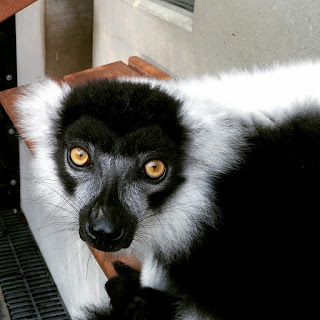
Halley, a black-and-white ruffed lemur at Duke Lemur Center.
Today is my last day at Duke Lemur Center (actually it was yesterday, the Duke Lemur Center is closed for July 4th this week). I've been here for about 2 months and I am very happy with my research progress. Although, I was naively expecting this to progress my faster. At first I thought I only needed a month to train the lemurs and another month for data collection (testing trials). Boy, was I wrong. I'm not, however, griping the fact that I have to stay in Durham, North Carolina longer than I expected to. I am actually enjoying working with the lemurs.

I am flying home this week and will stay in NYC for the rest of July. I will be back to Durham, North Carolina in August to continue working with the lemurs. Meanwhile my research assistant, Stephanie Tepper, will be helping me train the lemurs in my absence.

I am excited for this break because I cannot wait to spend time with my husband, and more importantly my cats. Also, I am not gonna front and tell you I won't miss the lemurs. Special shoutout to my puppy, Princess Luna Vagell, who is currently with her foster mama Jen. Love you all!!!

Tuesday, June 30, 2015

Meet the Scientist: Follow my ruffed lemur color vision study on #DukeLemurCenter Instagram. #SummerPrimate

I have been very fortunate to be granted access to post and talk about my research with the ruffed lemurs on Duke Lemur Center's Instagram page as part of their Meet the Scientist program. I will be posting pictures about my color vision research this whole week so head on to Duke Lemur Center's Instagram page to like, comment, and share my pictures. Have any questions about my research? Ask me on Instagram through Duke Lemur Center's page!

Please follow Duke Lemur Center on Facebook and Twitter as well. Keep the conversation going by following me on Twitter (@PrancingPapio). Let's talk lemur!

How do you tell a lemur to touch the red square? Similar to how you would train a dog, lemurs can be positively reinforced to exhibit the behavior you want by giving them a food reward when they did the correct behavior. Here I'm training AJ, one of the black-and-white ruffed lemurs (Varecia variegata), to touch the red square. We do something call chaining, where I chain a sequence of behaviors until the desired behavior is exhibited. Along the way, I give him dried cranberries as a food reward for a job well done! Are you wondering why I am training them to touch a red square? Stay tuned for more posts! Photo by @prancingpapio #dukelemurcenter #lemurs #lemur #lemuria #lemurian #animaltraining #positivereinforcement #primate #primateofinstagram #primates #ruffedlemur #blackandwhiteruffedlemur #varecia #variegata #colsci #color #colorvision #colorscience #psychophysics #psychophysiology #psychology #anthropology #primatology #SMARTA #prancingpapio
A photo posted by Duke Lemur Center (@dukelemurcenter) on

A photo posted by Duke Lemur Center (@dukelemurcenter) on