Showing posts with label tamarin. Show all posts

Monday, June 13, 2011

Maternal Infanticide and Cannibalism in Moustached Tamarin

Infanticide and cannibalism are two extreme behaviors seen in primates. Though extreme, the persistence of these behaviors in primates suggest that they are adapted for and had evolved to serve different purposes. Infanticide and cannibalism can be considered as both reproductive and survival strategies. Infanticide has always been associated with males killing off the progeny of former dominant males to make females more sexually receptive and to shorten the birth interval. Cannibalism, on the other hand, is not as sinister as it has always portrayed to be but just a coping mechanism. Ingestion of body parts, usually own offspring, is a response to cope with food scarcity. Lack of food resources would inevitably result in the death of the offspring thus cannibalization returns the caloric investment back into the mother. A new paper by Culot et al. (2011) has documented a case of infanticide and cannibalism in a wild female moustached tamarin (Saguinus mystax).

Moustached Tamarin (S. mystax) from The Bronx Zoo, New York City. Photo from Wikipedia.
S. mystax belong to the Callitrichid family, and like all Callitrichids has an interesting reproductive strategy unlike those of other primate families. Callitrichids form multimale-multifemale group and has a polyandrous (one female, multiple male) mating system. Callitrichids are the only primate family that consistently give birth to twins. The gestation period for S. mystax is 6 months. Usually, only one dominant female is reproductively active and shares offspring rearing responsibilities with multiple males in the group. However, an unstable dominance hierarchy among females might lead to multiple births within the group and will compromise the survivability of both the group and the offspring from stress, less parental investment and lack of food resources.

The researchers were studying how help from male moustached tamarins in the same group and the absence of female competition ensure the survival of offspring when they observed a female cannibalizing an infant. Necropsy and genetic analyses were used to rule out diseases and to determine paternity. They found that the infant has no diseases and did not die from trauma (falling from tree). Instead, it was a healthy infant and was being cannibalized by its own mother.
The mother was seen biting and then eating the head of its own infant during a period when another female was pregnant and gave birth just 1 month later. Before that, the perpetrator had given birth to twins three times successfully when four to five adult and subadult males were present in the group. Although we do not know for certain that the infant was alive when the mother started biting it, our field observations preceding the event suggest it probably was. The possible infanticide case and the two cases of births and early death of the infants occurred while only two to three adult males were present in the group. This could be the second case of maternal infanticide reported in the genus Saguinus and the similar circumstances suggest a common pattern. Culot et al. (2011).
Five common hypotheses proposed by Hrdy (1979) were used by the authors to try to explain maternal infanticide and cannibalism in this scenario. These hypotheses are resource competition, sexual selection, social pathology, exploitation, and parental manipulation.


The resource competition and sexual selection hypotheses were rejected because it was maternal infanticide, and not infanticide from another female. The social pathology hypothesis was rejected because it predicts infanticide restricted in areas that are disturbed by humans. The study group was habituated and had many successful births, therefore social pathology was ruled out. The exploitation hypothesis was also reject because the mother did not kill her infant to exploit its meat. Observation shows that the mother only consumed the brain and parts of the infant's neck. 


The parental manipulation hypothesis was accepted because the authors think that it best explains the scenario. The offspring was not pathological nor did it fell from the tree. Instead, it was a healthy infant that was killed by its own mother. According to Hrdy (1979), victim of parental manipulation does not necessarily have to be defective but also born "at the wrong place in the wrong time".

The authors concluded that parental manipulation is the best explanation for this possible maternal infanticide scenario. Parental manipulation strategy can happen in a group with poor capacity to raise the offspring from multiple breeding females, birth intervals that are shorter than 3 months, and low infant survival probability due to physical injuries or weakness.

References:

Culot, L. Lledo-Ferrer, Y. Hoelscher, O. Lazo, FJJM. Huynen, C. Heymann EW. 2011. Reproductive failure, possible maternal infanticide, and cannibalism in wild moustached tamarins, Saguinus mystaxPrimates 52(2): 179-186.

Hrdy, SB. 1979. Infanticide among animals: A review, classification, and examination of the implications for the reproductive strategies of females. Ethology and Sociobiology 1(1): 13-40.

Thursday, November 4, 2010

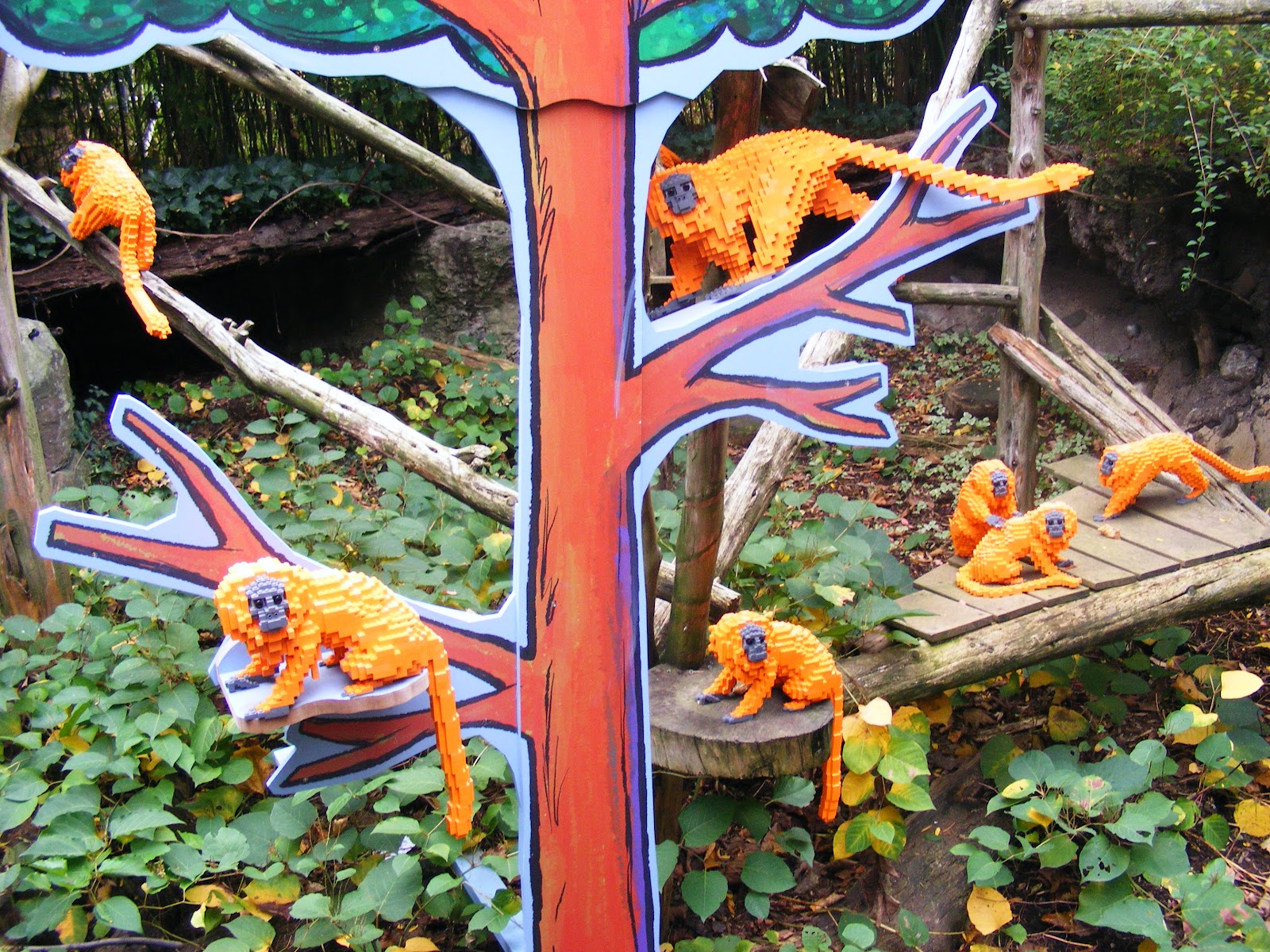
Legopithecus rosalia kenneyi

Wordless Wednesday are, well, meant to be "wordless" but I've gotten a lot of questions about my Wordless Wednesday post yesterday so I've decided to include more photos and write a little bit about these cute critters.


I was up in Philadelphia for the Halloween weekend and no trip to Philadelphia is complete without me going to The Philadelphia Zoo. While there, I managed to catch the Creatures of Habitat exhibit. The exhibits are made from LEGO bricks (OMG childhood memories) and my favorite were definitely the ones I've posted on my Wordless Wednesday post yesterday. 

They are, of course, the Golden Lion Tamarins (Leonpithecus rosalia) but the folks that made them did have a sense of humor. If you actually read the signs posted by the exhibit, you'll realize that the Latin name for these critters are Legopithecus rosalia kenneyi. Hah! Legopithecus (Lego ape). Brilliant. Although, for argument sake, Golden Lion Tamarins are not apes but monkeys

But why the kenneyi subspecies name? One of the artists that made these Lego sculptures is Sean Kenney, in which I would think where the subspecies name comes from (It's probably an Easter egg). I wonder what they plan to do with these sculptures when the exhibition is done. I'd love to get my fingers on one (maybe two). Here are more Lego Golden Lion Tamarin pictures from the Creatures of Habitat exhibit. Enjoy!

Only 12 individuals of this subspecies left!

 HAHAHA! Brilliant.

 Grooming.

 Pirate tamarin. Yarrr!

 Golden Lion Tamarin using a tool (stick). Not sure they do though ...

Friday, June 11, 2010

Name the Geoffroy’s tamarin twins

Photo by Julie Larsen Maher (WCS).

The Prospect Park Zoo wants you to help name their Geoffroy’s tamarin twins. Born in April Cannoli and her mate Napoleon, these twins are now about 2 months old and they need a name! Click here to suggest names for the twins. Winning names will be announced on June 21st online. I have personally submitted the name Maya and Milo. What do you think?

You can also watch a video of these babies and their parents on the zoo's website (click here). In the meantime, if you are at the zoo, say hi to the tamarin family in the Animal Lifestyle rotunda (where the Hamadryas baboons are also located!).

Geoffroy's tamarin (Saguinus geoffroyi) belongs to the Callitrichidae (Callitrichid) family. They are New World monkeys, native to Colombia and Panama. Mainly frugivores and insectivores, they do eat exudates (tree gums and tree saps) and green plant parts. Tamarins only feed on exudates when it is readily available, for example, holes left by wood-boring insects and rodents. Unlike marmosets (another Callitrichid), tamarins do not have the adaptation for gnawing on tree barks.


The difference between marmoset (left) and tamarin (right) lower dentition. Illustration from John Fleagle, Primate Adaptation and Evolution, Second Edition (1999).


Tamarin's dental morphology are not suited for gnawing on tree barks because their lower canines are longer than their lower incisors. Marmosets, on the other hand, has long forward turning lower incisors that are the same length as their canines.

Geoffroy's tamarin lives in a multimale-multifemale social system and a group generally consists of three to five individuals. Their mating system is usually polyandry (one female, multiple male). Geoffroy's tamarin, like all Callitrichids, almost always give birth to twins.

UPDATE: The twins were given the name "Tira" and "Misu".

Wednesday, July 15, 2009

New Tamarin Subspecies Found in Brazil

Researchers have discovered a new tamarin subspecies in the Amazon forest of Brazil. A subspecies of the saddleback tamarin, it was named Mura's saddleback tamarin (Saguinus fuscicollis mura) after the Mura Indians, the Amerindian ethnic group that lives in the Purus and Madeira river basins where the tamarins can be found.

Artist Stephen Nash's rendition of the recently discovered Mura's saddleback tamarin. Picture from Mongabay.com

This new subspecies has a gray and dark brown pelage and a distinctly mottled "saddle". Its coloration is distinct than the two of its geographically closest relatives, the Wendell's saddleback tamarin (Saguinus fuscicollis weddelli) and Avila Pires' saddleback tamarin (Saguinus fuscicollis avilapiresi). The Mura's saddleback tamarin weighs about 213 grams (less than 3/4 pounds) and is 240 millimeters (9 inches) tall with a 320 millimeter (12.6 inch) tail.

The discovery was published in the June online edition of the International Journal of Primatology: A New Subspecies of Saguinus fuscicollis (Primates, Callitrichidae) by Fabio Röhe, José de Sousa e Silva, Ricardo Sampaio and Anthony B. Rylands.